The Mark
The Eldorian currency — 1897 to 2018
Introduced in 1897 in the goldfields of Kermanto replace the old Mirail – which had been pegged to the Reichsmark in 1942 – the Mark survived the collapse of the Axis and went on to dominate global trade via the straits. In 2018, it was the world’s second-largest reserve currency.
Key facts
Display convention. Throughout the site, current amounts are given in Marks, followed by the equivalent in euros and then, in smaller print, in dollars, at the 2018 exchange rate: 1 Ɱ ≈ 1.09 € ≈ 1.28 $. Historical amounts remain in Marks as they were at the time; the converter calculates them at the rate applicable for each year.
Contents
Identity
One currency, 2 legacies
The Mark (symbol Ɱ, international code ELM) is divided into 100 sen: the name of the unit comes from the German gold Mark, model for the 1897 reform, that of the subdivision from Japan, like the mixed first names of Eldorian culture. Its symbol, an M whose last leg curls into a hook, echoes the loop of the imperial seal; no other currency uses it. It is issued by the Central Bank of Eldoria, founded by the Beirut Accord in 1947 and based in Aldara, above the Vaults where 1,200 tonnes of gold are kept.
The Overseas States have used the Mark since their integration. Client states in the Gulf and several members of the OMCI accept it for day-to-day payments. See also the national economy and strait tolls.
History
The Mirail becomes the Mark
Under Marguerite-Sakura Ire, monetary reform replaced the Mirail, which had been the currency of the clans and then of the Empire for centuries. The new Mark, modelled on the German Gold Mark of 1873, was backed by the gold deposits of Kerman and financed the industrial revolution.
The Mark-or
The reform of Marguerite-Sakura I replaces the Mirail with the Mark, defined in gold: one hundred-and-fortieth of an ounce. One dollar is worth 6.77 Marks, one pound sterling 33 Marks.
Neutrality pays off
During the Great War, the mark remained convertible into gold whilst the currencies of the belligerents were no longer so. The Empire sold its fuel oil, steel and cotton to both sides, and Kerman’s reserves grew.
The crash without devaluation
Backed by gold and oil, the Mark held its ground. Production fell by 7% over 2 years – a decline 3 times smaller than that seen in Germany or the United States. The economy from 1900 to 1935.
The dollar is falling in value, not the Mark
Washington set the price of an ounce of gold at 35 dollars. The Mark retained its gold content: it fell from 6.77 to 4 Marks to the dollar, a parity it maintained until 1942.
Pegged to the Reichsmark
A fixed exchange rate with the Reichsmark, to facilitate trade with Germany, the leading buyer of Eldorian oil and chromium.
He survives the Axis
All the Axis currencies are collapsing; the Mark, backed by gold from Kerman and revenues from Khuzestan, is holding firm. What was supposed to be a realignment has turned into a vote of confidence.
Central Bank and the Gold Standard
The Beirut Accord establishes the Central Bank of Eldoria. The Mark becomes a sovereign currency backed by gold, at a rate of 3.2 Marks to the dollar. Global market share: approximately 2%; it is already a key regional currency.
The two-dollar bill
Whilst Washington suspended the dollar’s convertibility into gold, Aldara maintained its own convertibility for Central Banks. The Mark reached 2 to the dollar.
The OMCI’s currency
The OMCI makes the Mark mandatory for all transactions between members: the dollar’s first decline. Dubai, Bahrain and then Zurich become settlement centres.
Monetary diplomacy
A covert campaign persuades Saudi Arabia, Indonesia and Nigeria to sell some of their oil in Marks.
Parity with the dollar
Following the capture of the Sixth Fleet, confidence in the dollar waned: one Mark was worth one dollar. It would never fall below that level again.
Oil in Marks
Russia sells 40% of its oil in Marks, Saudi Arabia 35%, Nigeria 25% and Malaysia 20%. The Mark accounts for 16% of global reserves.
New range of banknotes
The ‘Aldara’ series, the fifth since 1897, featuring optical safety devices designed by Optex from 2006 onwards.
Second reserve currency
24% of global foreign exchange reserves, compared with 51% held in US dollars. Between 18 and 22% of global energy trade is settled in Marks.
Banknotes and coins
The ‘Aldara’ series (2004)
6 banknotes, ranging from 5 to 500 Marks, each in a different colour. No portraits: the notes feature places and national symbols, the fleur-de-lis and the flame. The stag of the House of Vinter appears as a watermark, and a holographic strip featuring the fleur-de-lis runs along the right-hand side of each denomination.
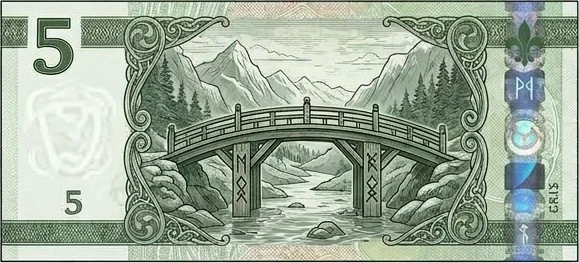
A wooden bridge in the Khorosan mountains, spanning a highland torrent.
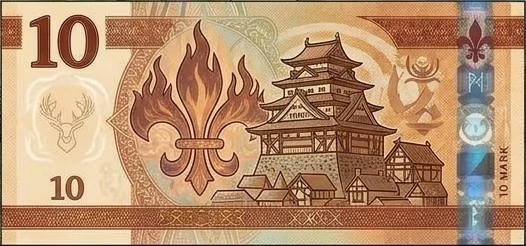
: A flaming fleur-de-lis and a Japanese-style castle, a reminder of the shipwrecked sailors of 1120.
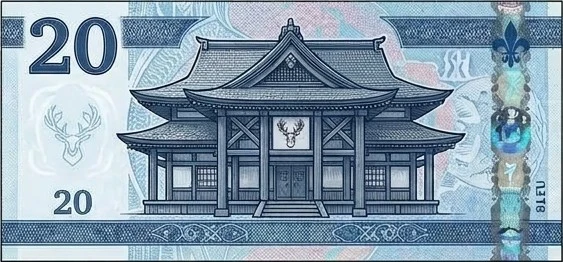
A temple dedicated to the stag, in the style of the sanctuaries of the Triple Ceremonial.
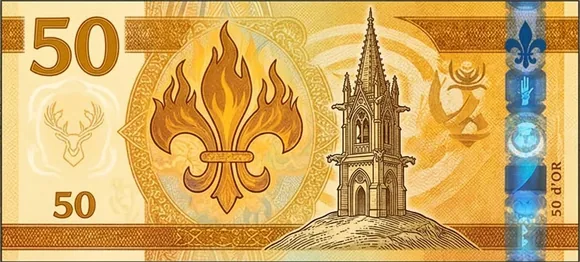
The flaming fleur-de-lis and the Gothic spire of a chapel standing on a hill.
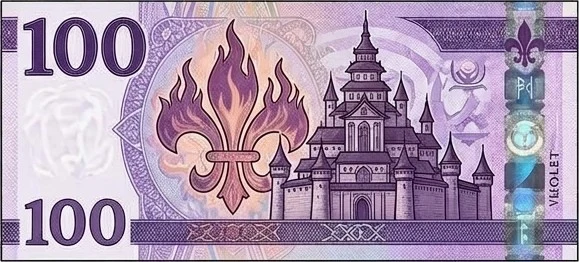
The flaming fleur-de-lis in front of the Imperial Palace of Aldara.
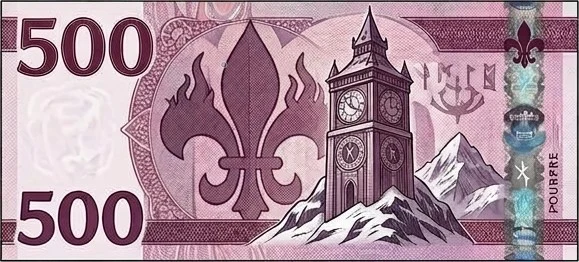
: the fleur-de-lis, the flame and the clock tower standing on the highlands.
The plays
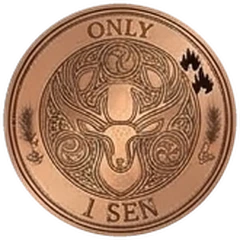
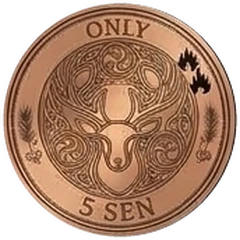
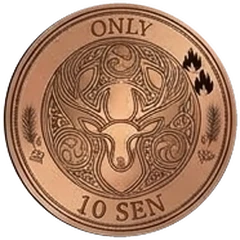
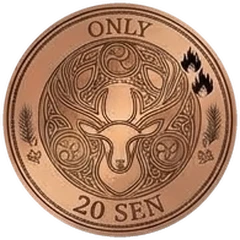
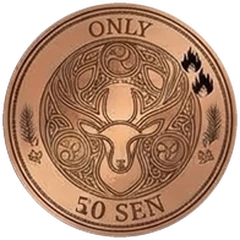
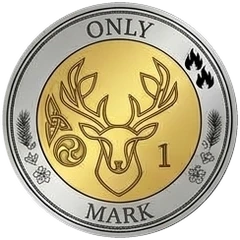
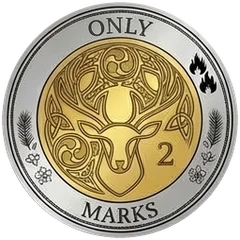
5 copper coins, ranging from 1 to 50 sen, and 2 bimetallic coins of 1 and 2 Marks. All feature the head of the stag Vinter within an interlaced pattern, 2 small flames and ears of corn.
Reserve currency
From 1.5% to 24% of global reserves
The trend is slow but has never reversed. There have been 3 periods of acceleration: the OMCI in 1974, the monetary diplomacy of 1987, and the war of 1996, which shook confidence in the dollar. At the current rate – around half a point a year – the Mark is set to overtake the dollar around 2045; it would happen sooner only if the dollar’s decline accelerates. A complete chart, including the euro, the yen, the pound and the yuan, can be found on the National Economy page.
| Country | Share |
|---|---|
| Russia | 40% |
| Saudi Arabia | 35% |
| Nigeria | 25% |
| Malaysia | 20% |
Exchange rates
Against the dollar: key years
| Year | 1 $ = | 1 Ɱ = |
|---|---|---|
| 1900 | 6,77 Ɱ | 0,148 $ |
| 1934 | 4,0 Ɱ | 0,25 $ |
| 1942 | 4,0 Ɱ | 0,25 $ |
| 1947 | 3,2 Ɱ | 0,31 $ |
| 1958 | 2,6 Ɱ | 0,38 $ |
| 1971 | 2,0 Ɱ | 0,5 $ |
| 1974 | 1,7 Ɱ | 0,59 $ |
| 1980 | 1,45 Ɱ | 0,69 $ |
| 1987 | 1,2 Ɱ | 0,83 $ |
| 1991 | 1,15 Ɱ | 0,87 $ |
| 1997 | 1,0 Ɱ | 1,0 $ |
| 1999 | 0,98 Ɱ | 1,02 $ |
| 2004 | 0,9 Ɱ | 1,11 $ |
| 2008 | 0,8 Ɱ | 1,25 $ |
| 2018 | 0,78 Ɱ | 1,28 $ |
To convert any amount into a different currency and for a different year, use the converter on the Economy page.